Sourdough · Easy
Beginner Sourdough Bread (70% Hydration)
A 70% hydration sourdough loaf that is easy to shape. Scale it to any number of loaves, plan the bake around your day and open the formula in the sourdough calculator.
- Hydration
- 70%
- Total time
- 1 d 40 min
- Hands-on
- 35 min
- Makes
- 1 loaf
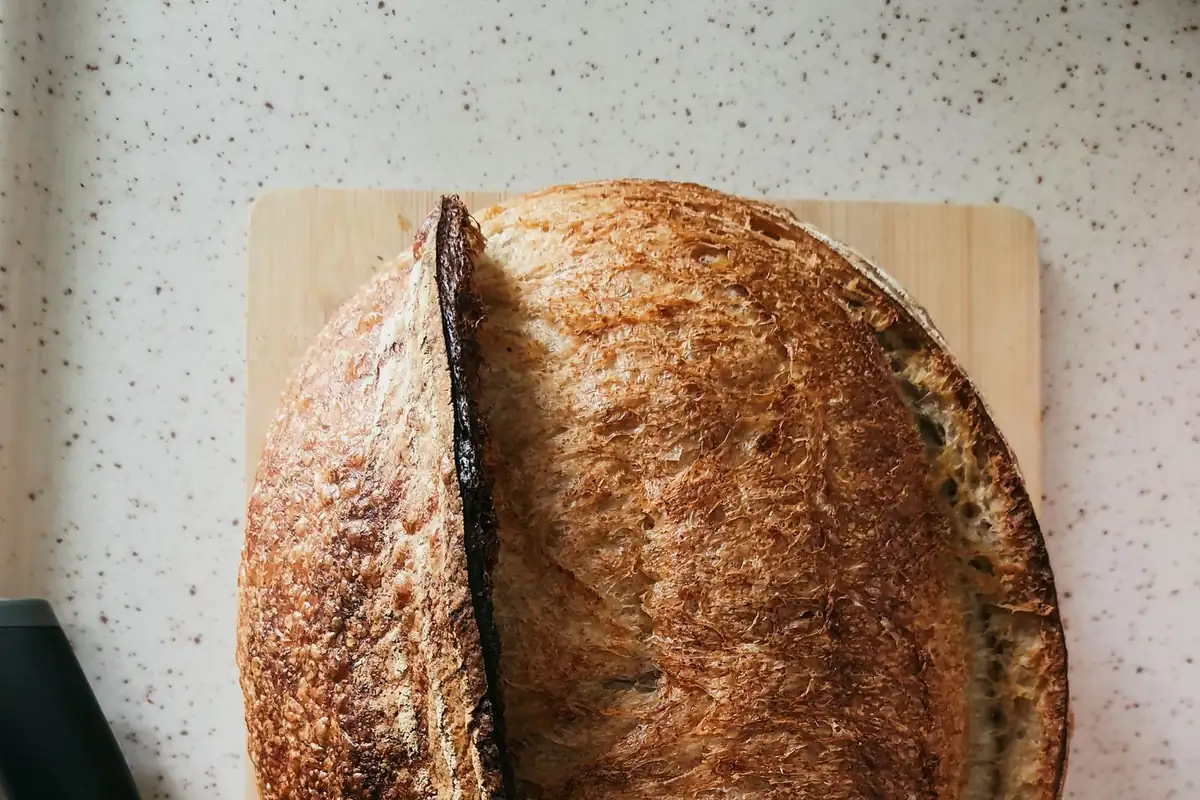
If you are learning sourdough, start here. At 70% the dough is soft enough to rise into a light, open loaf but firm enough that you can shape it without it gluing itself to your hands. Most bakers who get good at sourdough spent their first few months at about this number.
The 10% whole wheat is there on purpose. It gives the starter a little more to eat during the long rise, and it adds a nutty depth you will miss if you leave it out.
Formula
Change the count or piece weight and every gram updates. Percentages are of total flour, including the flour in any starter or preferment.
| Ingredient | Baker's % | Weight |
|---|---|---|
| Bread flour | 80% | 419 g |
| Whole wheat flour | 10% | 52 g |
| Ripe sourdough starter (100% hydration)Fed 4–8 hours before, doubled and domed | 20% | 105 g |
| Water, 27 °C (80 °F)Hold back 20 g to mix in with the salt | 60% | 314 g |
| Fine sea salt | 2% | 10 g |
| Total dough | 900 g | |
| Total flour · water | 523 g · 366 g | |
| Hydration | 70.0% |
What does this cost to make?About $1.57 per loaf at example US prices
| Ingredient | Cost |
|---|---|
| Bread flour | $1.20 |
| Whole wheat flour | $0.16 |
| Ripe sourdough starter (100% hydration) | $0.15 |
| Water, 27 °C (80 °F) | $0.00 |
| Fine sea salt | $0.06 |
| Ingredients | $1.57 |
| Per loaf | $1.57 |
| Per 100 g of dough (ingredients) | $0.17 |
| Suggested retail price | $4.75 |
| Suggested wholesale price | $3.00 |
Retail is 3× cost (a 67% margin), rounded up; wholesale is 60% of retail. The starter is costed as the flour and water in it, so it adds almost nothing. Example US prices (Nov 2026), ingredients only. Put in what you pay, plus packaging and your time, in the cost calculator.
Use your own prices →Nutrition per serving (estimate), 1/9 of the loaf · 210 kcal · carbs 42 g · protein 7 g · fat 1 g · fiber 2 g · sodium 450 mg. Worked out from the ingredient weights above, toppings and fillings included.
A scale that reads single grams and a heavy lidded pot matter most. The pot traps steam for the first 20 minutes, which is what lets the loaf rise before the crust sets.
Why 70% hydration
Sourdough is usually made somewhere between 65% and 85%. Below 70% the crumb is tighter and the dough is easy to handle. Above 75% you get bigger holes, but the dough spreads unless your shaping is good. 70% is the point where you can get a good-looking loaf without much practice.
Your flour moves this number. If it is weak (under about 11% protein) or the air is humid, drop to 68% by holding back another 10 g of water for every 500 g of flour. If the dough feels stiff at the first fold, wet your hand and work in 10–20 g more.
The percentages count the flour and water inside the starter. That is how the sourdough calculator works too, so the numbers match when you check them there.
Reading bulk fermentation
Temperature runs the show. Dough at 21 °C (70 °F) can take twice as long as dough at 26 °C (79 °F). Use a straight-sided container and mark where the dough starts with tape. You stop when it has grown by about half, not when an app says so.
If your kitchen is cold, warm the water so the dough starts at about 25 °C. The water temperature calculator works out how warm it needs to be from your room and flour temperature.
Method and schedule
- Feed the starter : 5 min, hands-on.
- Starter rises : 5 h, waiting.
- Mix flour and water : 5 min, hands-on, during starter rises.
- Rest (autolyse) : 45 min, waiting, during starter rises.
- Add starter and salt : 10 min, hands-on.
- Bulk ferment with folds : 5 h, waiting.
- Pre-shape and rest : 30 min, hands-on.
- Shape : 10 min, hands-on.
- Cold proof : 12 h, waiting.
- Heat the oven and pot : 45 min, oven, during cold proof.
- Score and bake : 45 min, oven.
- Cool : 1 h, waiting.
Pick a start time, or the time you want it ready, and each step gets a clock time. Tick steps off as you go; this page remembers your place on this device.
Plan your bakeTotal time 1 d 40 min
1 Feed the starter
Feed your starter so it peaks when you mix. A 1:1:1 feed (equal weights of starter, flour and water) at about 24 °C (75 °F) usually peaks in 4–6 hours. Make a little more than the recipe needs so you have some to keep.
2 Starter rises
Leave it somewhere warm. Put a rubber band around the jar at the starting level so you can see the rise.
Look for: Doubled or more, domed on top, bubbly all through, and it smells sour-sweet rather than sharp.
3 Mix flour and water
About an hour before the starter peaks, stir the two flours with all but 20 g of the water. Mix until you can’t see dry flour. It will look shaggy. That’s fine.
4 Rest (autolyse)
Cover the bowl and leave it while the starter finishes. The flour soaks up the water and the dough starts to come together without any work from you.
5 Add starter and salt
Spread the starter over the dough, sprinkle on the salt and pour the held-back water over the top. Pinch it all through with a wet hand, then fold the dough over itself until it feels like one piece again. Three or four minutes.
Look for: No streaks of starter, and the dough has gone from torn to smooth-ish.
6 Bulk ferment with folds
Keep the dough at 24–26 °C (75–79 °F). Every 30 minutes for the first two hours, wet your hand, lift one side of the dough and fold it over to the other side. Turn the bowl and repeat on all four sides. After the fourth set, leave it alone. This takes 4–6 hours in all; a cool kitchen takes longer, and that’s normal.
Stretch and fold - Lift one sideWet hand, stretch until it resists
- Fold it overLay it on the far side
- Turn the bowlRepeat on all four sides
Look for: About 50% bigger, domed, a few bubbles on top and on the sides, and it wobbles when you shake the bowl.
7 Pre-shape and rest
Tip the dough out onto a clean, unfloured counter. Use a bench scraper to push it into a loose round, then leave it uncovered for 20–30 minutes.
Look for: The round has slumped a little and the surface looks smooth.
8 Shape
Flour the top lightly and flip it over. Fold the sides in like an envelope, then roll it up towards you, pulling it against the counter so the skin tightens. Drop it seam side up into a floured basket or a bowl lined with a floured tea towel.
Look for: A taut surface that holds its shape for a few seconds when you let go.
9 Cold proof
Cover and put it in the fridge for 8–16 hours. This is your flexible step: bake it after breakfast or after work.
The poke test - Springs right backNeeds more time
- Fills in slowlyReady to bake
- Dent staysOver-proofed: bake now
Look for: Poke it with a floured finger. The dent should fill back in slowly, not spring right out or stay put.
10 Heat the oven and pot
With 45–60 minutes of the proof left, put a Dutch oven or combo cooker in the oven and heat it to 250 °C (480 °F). The pot needs that time to soak up heat.
11 Score and bake
Turn the loaf out onto parchment, cut one long slash about 1 cm deep and lower it into the pot. Bake 20 minutes with the lid on. Then lower the oven to 230 °C (450 °F), take the lid off and bake 20–25 minutes more.
Look for: A deep chestnut crust, darker than you think. The middle reads 96–99 °C (205–210 °F).
12 Cool
Cool it on a rack for at least an hour. The inside is still cooking. Cut it early and the crumb turns gummy.
Troubleshooting
- Flat loaf that spreads in the oven: bulk went too long or not long enough. Check against the 50% rise and do the poke test before baking.
- Dense crumb with a few big holes under the crust: under-fermented. Give bulk another hour next time.
- Pale crust: bake longer with the lid off. Most home loaves come out 5–10 minutes too early.
- Dough tears when you fold it: it needs to rest. Wait 15 minutes and try again.
Baker's notes
Once you have made it as written, these are the changes worth trying.
- Build a levain instead of using starter straight: 20 g starter, 50 g flour, 50 g water, about 5 hours at 25 °C, and you have a cleaner, milder loaf.
- Swap the whole wheat for whole rye at the same 10% for a darker crust and a more sour loaf. Rye ferments faster, so watch bulk.
- Inclusions (seeds, olives, cheese) go in at the second set of folds, up to 20–25% of the flour weight.
Questions
Can I use all-purpose flour instead of bread flour?
Yes. All-purpose holds less water, so start at 66–68% by holding back 15–20 g of water for a 900 g loaf. Add it at the first fold if the dough feels stiff.
Can I skip the cold proof?
You can proof the shaped loaf at room temperature for 1–2 hours instead. It will taste milder and be harder to score, but it works.
How much starter do I need to feed?
One 900 g loaf needs 105 g of ripe starter. Feed about 40 g of starter with 40 g flour and 40 g water, and you will have enough plus some to keep.
Bake next
Feedback on this recipe
Formula and method by the BreadHydration team, written for home ovens and checked against our calculators. Photo by Ece Ebrar TOYCU on Pexels, used under the Pexels license; it shows this style of bread, not our own bake. Found an error? Tell us.