Sourdough · Easy
Sourdough Sandwich Bread
A soft sourdough sandwich loaf made with milk, butter and honey, baked in a 9×5 loaf pan. Effective hydration about 71%. Scale it to more pans and plan the bake.
- Hydration
- 71%
- Total time
- 15 h 50 min
- Hands-on
- 35 min
- Makes
- 1 loaf (9×5 in pan)
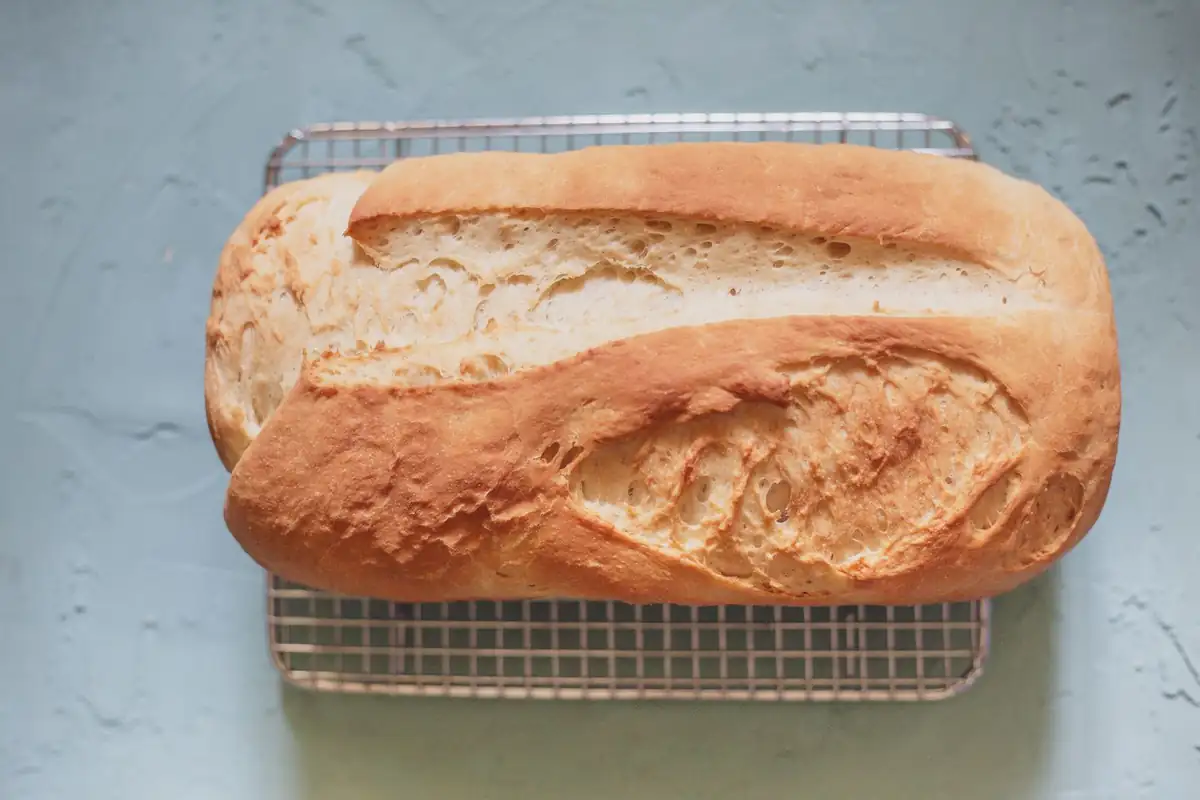
This is the sourdough that goes in lunchboxes: soft, even crumb, thin crust and only a gentle tang. Milk, butter and a little honey keep it tender and slow it from going stale, so it still makes good toast on day four.
Milk is mostly water, so the formula counts it. The dough works out to about 71% effective hydration, even though most of the liquid is milk.
Formula
Change the count or piece weight and every gram updates. Percentages are of total flour, including the flour in any starter or preferment.
| Ingredient | Baker's % | Weight |
|---|---|---|
| Bread flour | 90% | 424 g |
| Ripe sourdough starter (100% hydration)Fed 4–8 hours before, doubled and domed | 20% | 94 g |
| Whole milkLukewarm | 50% | 236 g |
| Water | 15% | 71 g |
| Unsalted butter, soft | 8% | 38 g |
| Honey | 6% | 28 g |
| Fine sea salt | 2% | 9.4 g |
| Total dough | 900 g | |
| Total flour · water | 471 g · 334 g | |
| Hydration | 70.8% |
What does this cost to make?About $2.68 per loaf (9×5 in pan) at example US prices
| Ingredient | Cost |
|---|---|
| Bread flour | $1.21 |
| Ripe sourdough starter (100% hydration) | $0.13 |
| Whole milk | $0.26 |
| Water | $0.00 |
| Unsalted butter, soft | $0.46 |
| Honey | $0.56 |
| Fine sea salt | $0.05 |
| Ingredients | $2.68 |
| Per loaf (9×5 in pan) | $2.68 |
| Per 100 g of dough (ingredients) | $0.30 |
| Suggested retail price | $8.25 |
| Suggested wholesale price | $5.00 |
Retail is 3× cost (a 68% margin), rounded up; wholesale is 60% of retail. The starter is costed as the flour and water in it, so it adds almost nothing. Example US prices (Nov 2026), ingredients only. Put in what you pay, plus packaging and your time, in the cost calculator.
Use your own prices →Nutrition per serving (estimate), 1/9 of the loaf (9×5 in pan) · 245 kcal · carbs 42 g · protein 7 g · fat 5 g · fiber 1 g · sodium 420 mg. Worked out from the ingredient weights above, toppings and fillings included.
The loaf pan does the shaping for you. The thermometer tells you when an enriched loaf is done, since the crust browns early.
Matching dough to your pan
A 9×5 inch pan wants about 900 g of dough. Use less and the loaf looks squat; more and it spills over the sides. For an 8.5×4.5 inch pan, scale to about 780 g using the scaler above.
For a 13×4 inch Pullman pan with the lid on, use about 1,000 g and bake 5–10 minutes longer. A lidded pan needs about 1 g of dough for every 3.5 ml it holds, or the loaf comes out dense.
Keeping the tang mild
Warm, short fermentation gives a mild loaf. Keep the dough at 25–26 °C and proof at room temperature. If your family likes it more sour, do the final proof in the fridge overnight.
Method and schedule
- Feed the starter : 5 min, hands-on.
- Starter rises : 5 h, waiting.
- Mix : 15 min, hands-on.
- Work in the butter : 10 min, hands-on.
- Bulk ferment : 5 h, waiting.
- Shape : 10 min, hands-on.
- Final proof : 3 h, waiting.
- Heat the oven : 20 min, oven, during final proof.
- Bake : 40 min, oven.
- Cool : 1 h 30 min, waiting.
Pick a start time, or the time you want it ready, and each step gets a clock time. Tick steps off as you go; this page remembers your place on this device.
Plan your bakeTotal time 15 h 50 min
1 Feed the starter
Feed your starter so it peaks when you mix. A 1:1:1 feed (equal weights of starter, flour and water) at about 24 °C (75 °F) usually peaks in 4–6 hours. Make a little more than the recipe needs so you have some to keep.
2 Starter rises
Leave it somewhere warm. Put a rubber band around the jar at the starting level so you can see the rise.
Look for: Doubled or more, domed on top, bubbly all through, and it smells sour-sweet rather than sharp.
3 Mix
Mix the flour, starter, milk, water, honey and salt until there is no dry flour. Rest 20 minutes, then knead by hand or machine for about 5 minutes.
Look for: Fairly smooth and springy, not yet silky.
4 Work in the butter
Add the soft butter a piece at a time. The dough will go slippery and fall apart, then pull back together. Keep going until it does. Butter added late lets the gluten form first.
Look for: Smooth, a little shiny, and it stretches thin without tearing straight away.
5 Bulk ferment
At 25 °C (77 °F), let it rise, with two sets of folds in the first hour. Milk and butter slow a starter down a little, so give it 5–6 hours.
Look for: Around 75% bigger and soft and airy when pressed.
6 Shape
Roll the dough into a rectangle as wide as your pan. Press out any big bubbles, roll it up tightly and pinch the seam. Seam down into a buttered 9×5 in (23×13 cm) pan.
7 Final proof
Cover and let it rise at room temperature for 2–4 hours. Or put it in the fridge overnight and let it finish in the morning.
Look for: The top has crowned about 2 cm above the rim of the pan.
8 Heat the oven
Heat the oven to 190 °C (375 °F) while the loaf finishes rising.
9 Bake
Bake 35–40 minutes. Brush the top with butter as it comes out if you like a softer crust.
Look for: Golden on top and sides, and the middle reads 88–93 °C (190–200 °F).
10 Cool
Turn it out of the pan after 10 minutes and let it cool completely on a rack before you slice.
Troubleshooting
- Big hole under the top crust: it was rolled loosely. Roll tighter and press out large bubbles first.
- Crust too dark: honey and milk brown quickly. Lay foil over the top after 25 minutes.
- Loaf sinks a little after baking: over-proofed or under-baked. Check the inside temperature.
Baker's notes
Once you have made it as written, these are the changes worth trying.
- Add a 5% tangzhong (see the milk bread recipe) for an even softer crumb that keeps a day longer.
- Swap 20% of the flour for whole wheat and add 5 g more water per 100 g swapped.
- For burger buns, divide into 90 g pieces, proof on a tray and bake 15–18 minutes at 200 °C.
Questions
Can I use oil instead of butter?
Yes, the same weight of a neutral oil. The crumb is a little less rich but just as soft.
Can I make it dairy-free?
Swap the milk for water at about 87% of its weight (for 500 g of flour, 290 g milk becomes about 250 g water) and use oil instead of butter.
How long does it keep?
About 4 days in a bread bag at room temperature. Slice and freeze for longer.
Bake next
Feedback on this recipe
Formula and method by the BreadHydration team, written for home ovens and checked against our calculators. Photo by Noemí Jiménez on Pexels, used under the Pexels license; it shows this style of bread, not our own bake. Found an error? Tell us.