Yeasted bread · Easy
Focaccia (80% Hydration)
A light, bubbly focaccia at 80% hydration with an overnight rise in the fridge. No kneading, no shaping: folds build the dough and the pan does the rest. Scale it to your pan.
- Hydration
- 80%
- Total time
- 22 h 5 min
- Hands-on
- 30 min
- Makes
- 1 9×13 in pan
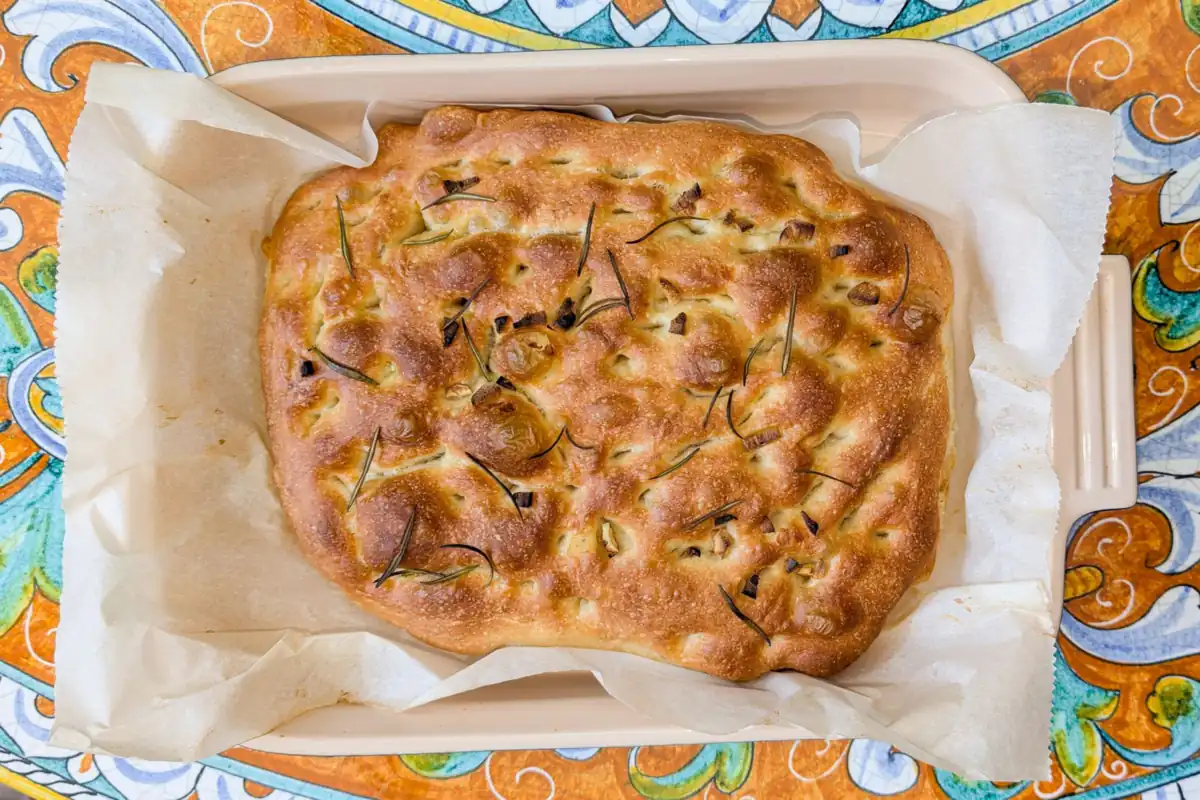
Focaccia is the easiest way to bake a really wet dough. At 80% hydration it would be hard to shape into a loaf, but the pan does the shaping for you, and all that water turns into a light, bubbly crumb under a crisp, oily crust.
There is no kneading. Four sets of folds build the strength, and a night in the fridge builds the flavour. You need about 30 minutes of hands-on time spread over two days.
Formula
Change the count or piece weight and every gram updates. Percentages are of total flour, including the flour in any starter or preferment.
| Ingredient | Baker's % | Weight |
|---|---|---|
| Dough | ||
| Bread flour | 100% | 501 g |
| Water, 30 °C (86 °F)Hold back 40 g per 500 g flour to add after the first fold | 80% | 401 g |
| Fine sea salt | 2.4% | 12 g |
| Instant yeast | 0.6% | 3.0 g |
| Extra virgin olive oil | 4% | 20 g |
| Topping | ||
| Extra virgin olive oil, for the pan and top | 8% | 40 g |
| Flaky sea saltPlus rosemary, olives or tomatoes if you like | 0.6% | 3.0 g |
| Total dough | 980 g | |
| Total flour · water | 501 g · 401 g | |
| Hydration | 80.0% | |
What does this cost to make?About $2.53 per 9×13 in pan at example US prices
| Ingredient | Cost |
|---|---|
| Bread flour | $1.43 |
| Water, 30 °C (86 °F) | $0.00 |
| Fine sea salt | $0.07 |
| Instant yeast | $0.06 |
| Extra virgin olive oil | $0.32 |
| Extra virgin olive oil, for the pan and top | $0.64 |
| Flaky sea salt | $0.02 |
| Ingredients | $2.53 |
| Per 9×13 in pan | $2.53 |
| Per 100 g of dough (ingredients) | $0.26 |
| Suggested retail price | $7.75 |
| Suggested wholesale price | $4.75 |
Retail is 3× cost (a 67% margin), rounded up; wholesale is 60% of retail. Example US prices (Nov 2026), ingredients only. Put in what you pay, plus packaging and your time, in the cost calculator.
Use your own prices →Nutrition per serving (estimate), 1/10 of the 9×13 in pan · 235 kcal · carbs 37 g · protein 6 g · fat 7 g · fiber 1 g · sodium 585 mg. Worked out from the ingredient weights above, toppings and fillings included.
A heavy metal pan browns the base best; glass and thin pans give a pale bottom. A scale matters more than usual here, because a little extra water goes a long way at 80%.
Why 80% hydration
Most focaccia recipes sit between 70% and 85%. Below 75% the crumb is tighter and more bready. Around 80% you get the big, uneven holes people want, and the dough is still easy to move into the pan.
Olive oil adds no water, so it does not count toward hydration. The 4% in the dough softens the crumb; the oil in the pan fries the base.
Changing the pan
Thickness is what matters, not the shape. This recipe gives about 2.5 cm of baked focaccia in a 9×13 in pan. The focaccia pan calculator scales the dough for a round pan, a half sheet or several small pans and keeps the thickness the same.
Method and schedule
- Mix : 10 min, hands-on.
- Rest : 30 min, waiting.
- Folds : 2 h, waiting.
- Cold rise : 16 h, waiting.
- Pan it : 10 min, hands-on.
- Proof in the pan : 2 h 30 min, waiting.
- Heat the oven : 45 min, oven, during proof in the pan.
- Dimple and top : 5 min, hands-on.
- Bake : 25 min, oven.
- Cool : 15 min, waiting.
Pick a start time, or the time you want it ready, and each step gets a clock time. Tick steps off as you go; this page remembers your place on this device.
Plan your bakeTotal time 22 h 5 min
1 Mix
Stir the flour, yeast and all but the held-back water in a large bowl until no dry flour is left. Add the salt and the dough oil, then the held-back water a splash at a time, squeezing it through with a wet hand.
Look for: One shaggy, very wet mass with no dry patches.
2 Rest
Cover and leave it 30 minutes. The flour hydrates and the dough starts to come together on its own.
3 Folds
Every 30 minutes for two hours, wet your hands, lift the dough from the middle and let it fold under itself, then turn the bowl and repeat. Four sets in all. Between sets, leave it covered.
Coil fold - Lift from the middleUntil it lets go of the container
- Let the ends tuck underLower it gently
- Turn a quarterLift and tuck again
Look for: Smooth and stretchy, holding a rounded shape in the bowl instead of flowing flat.
4 Cold rise
Move it to an oiled lidded container and refrigerate 12–24 hours. This is where the flavour and the big bubbles come from, and it fits around your day.
5 Pan it
Pour half the pan oil into a 9×13 in (23×33 cm) pan. Tip the cold dough in, turn it over to coat it, and gently stretch it towards the corners. If it springs back, leave it 15 minutes and try again.
6 Proof in the pan
Cover and leave it at room temperature for 2–3 hours, until it fills the pan.
Look for: Puffy, wobbly when you shake the pan, with large bubbles on top.
7 Heat the oven
For the last 45 minutes of the proof, heat the oven to 230 °C (450 °F) with a rack in the lower third.
8 Dimple and top
Drizzle on the rest of the oil. Oil your fingers and press straight down to the bottom of the pan all over, making deep dimples. Scatter the flaky salt and any toppings.
9 Bake
Bake 22–28 minutes.
Look for: Deep golden on top, and when you lift a corner the base is crisp and brown.
10 Cool
Lift it out of the pan onto a rack after 5 minutes so the base stays crisp. It is best warm, within a few hours.
Troubleshooting
- Dense and flat: the proof in the pan was too short. Wait until it is puffy and fills the corners.
- Pale and soft on the bottom: the pan was too thin or the oven too cool. Bake on the lowest rack, or on a steel.
- Huge blisters on top: normal. Pop any that look like they will burn.
- Dough won’t reach the corners: it is still cold. Give it 15 minutes and stretch again.
Baker's notes
Once you have made it as written, these are the changes worth trying.
- Same day: use 1% yeast, skip the fridge and give it 1–1.5 hours after the folds before it goes in the pan.
- Swap 10–20% of the flour for semolina rimacinata for a golden, slightly crunchy crumb.
- For a sourdough version, replace the yeast with 20% ripe starter and allow 3–4 hours at room temperature before the fridge.
Questions
Can I use all-purpose flour?
Yes. Lower the water to 75%, because all-purpose holds less. The crumb will be a little softer and less open.
How long can the dough stay in the fridge?
Up to 48 hours. It gets more sour and a little slacker the longer it goes.
How do I keep leftover focaccia?
Wrap it at room temperature for a day, then freeze in pieces. Reheat in a hot oven for 5 minutes.
Bake next

Feedback on this recipe
Formula and method by the BreadHydration team, written for home ovens and checked against our calculators. Photo by George Piskov on Pexels, used under the Pexels license; it shows this style of bread, not our own bake. Found an error? Tell us.