Pastry · Hard
Croissants (Laminated Dough)
Homemade croissants with a butter block worked into the dough with three letter folds. Exact grams for any batch size and a two-day schedule. Open it in the croissant calculator.
- Hydration
- 51%
- Total time
- 17 h 45 min
- Hands-on
- 1 h 30 min
- Makes
- 12 croissants
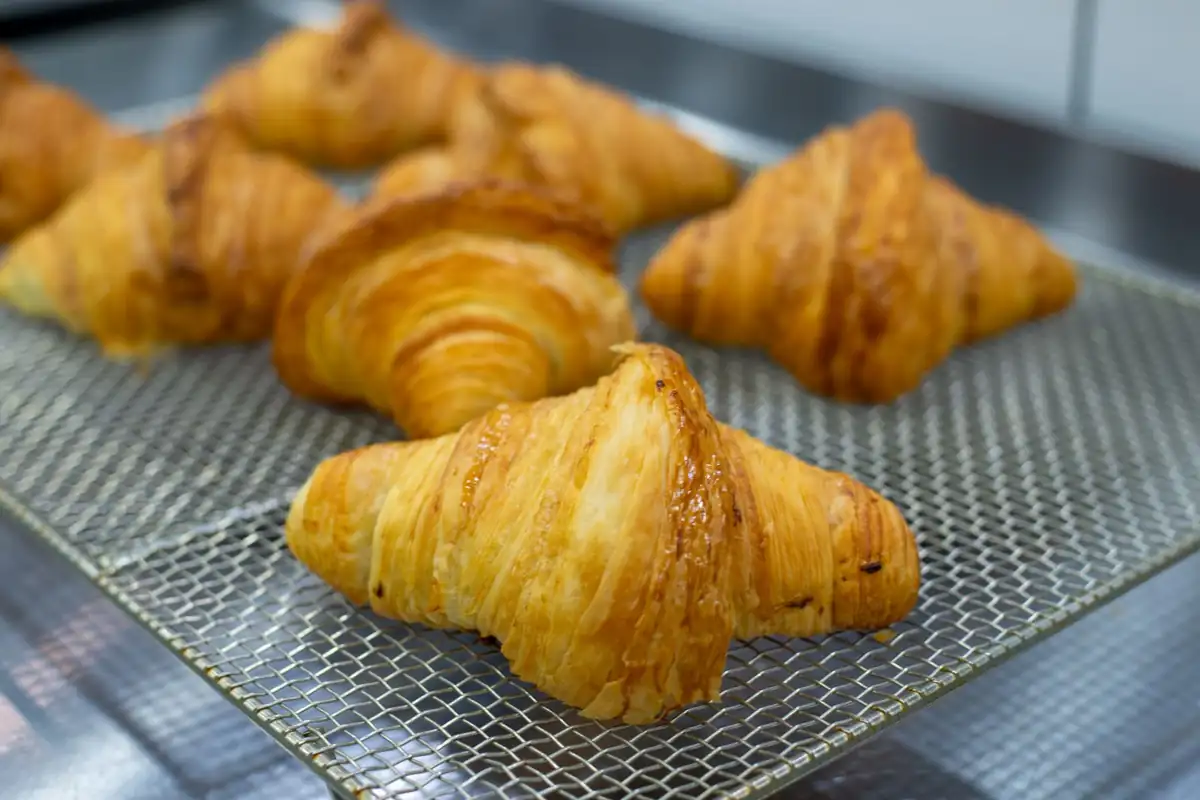
Croissants are a lean, slightly sweet dough with a sheet of butter folded through it, again and again. Each fold multiplies the layers. In the oven, the water in the butter and dough turns to steam and pushes the layers apart. That is the honeycomb.
They take two days and some patience with temperature, but no single step is hard. The whole game is keeping the butter and the dough at about the same firmness, so they stretch together.
Formula
Change the count or piece weight and every gram updates. Percentages are of total flour, including the flour in any starter or preferment.
| Ingredient | Baker's % | Weight |
|---|---|---|
| Dough | ||
| Bread flour or strong all-purpose | 100% | 424 g |
| Whole milkCold | 30% | 127 g |
| Cold water | 25% | 106 g |
| Sugar | 12% | 51 g |
| Instant yeast | 1.3% | 5.5 g |
| Fine sea salt | 2% | 8.5 g |
| Unsalted butter, soft | 6% | 25 g |
| Butter block | ||
| Unsalted butter, cold (high-fat)82% fat or more | 50% | 212 g |
| Total dough | 960 g | |
| Total flour · water | 424 g · 217 g | |
| Hydration | 51.1% | |
What does this cost to make?About $0.38 per croissant at example US prices
| Ingredient | Cost |
|---|---|
| Bread flour or strong all-purpose | $1.21 |
| Whole milk | $0.14 |
| Cold water | $0.00 |
| Sugar | $0.12 |
| Instant yeast | $0.11 |
| Fine sea salt | $0.05 |
| Unsalted butter, soft | $0.31 |
| Unsalted butter, cold (high-fat) | $2.57 |
| Ingredients | $4.50 |
| Per croissant | $0.38 |
| Per 100 g of dough (ingredients) | $0.47 |
| Suggested retail price | $1.25 |
| Suggested wholesale price | $0.75 |
Retail is 3× cost (a 70% margin), rounded up; wholesale is 60% of retail. Example US prices (Nov 2026), ingredients only. Put in what you pay, plus packaging and your time, in the cost calculator.
Use your own prices →Nutrition per serving (estimate), 1 croissant · 295 kcal · carbs 31 g · protein 5 g · fat 17 g · fiber 1 g · sodium 280 mg. Worked out from the ingredient weights above, toppings and fillings included.
A proofer holds the 24–26 °C that croissants need without melting the butter. A thermometer helps you read butter and room temperature, which decide whether lamination works. A long rolling pin and a ruler help too.
Hydration in laminated dough
Croissant dough is on the dry side, around 50–55%, because a soft dough smears the butter instead of carrying it in a sheet. Milk counts at about 87% water, so 30% milk and 25% water work out to roughly 51%. Bakers usually leave the butter out of this sum.
The butter block is 50% of the flour weight, which is about 22% of the finished dough. More butter gives richer, flakier croissants and is harder to laminate.
The butter matters
Use butter with at least 82% fat, often sold as European-style. Standard butter has more water: it cracks when cold and leaks when warm.
Method and schedule
- Mix the dough : 15 min, hands-on.
- Chill overnight : 12 h, waiting.
- Make the butter block : 15 min, hands-on, during chill overnight.
- Lock in the butter : 10 min, hands-on.
- Three letter folds : 2 h, hands-on.
- Roll and cut : 30 min, hands-on.
- Proof : 2 h 30 min, waiting.
- Heat the oven : 25 min, oven, during proof.
- Egg wash and bake : 20 min, oven.
Pick a start time, or the time you want it ready, and each step gets a clock time. Tick steps off as you go; this page remembers your place on this device.
Plan your bakeTotal time 17 h 45 min
1 Mix the dough
Mix everything except the butter block into a smooth, fairly firm dough, about 5 minutes. Don’t over-knead. The folds will build plenty of strength later.
2 Chill overnight
Flatten it into a square about 2 cm thick, wrap it and refrigerate overnight.
3 Make the butter block
In the morning, while the dough is still cold, beat the butter between two sheets of parchment with a rolling pin, then roll it into a square half the size of the dough square. Put it back in the fridge.
Look for: Cold but bendable: it flexes without cracking, about 12–15 °C (54–59 °F).
4 Lock in the butter
Roll the dough into a square twice the size of the butter. Lay the butter on it turned like a diamond and fold the four corners of the dough over it, pinching the seams shut.
5 Three letter folds
Roll it into a long rectangle about 7 mm thick and fold it in thirds like a letter. Wrap and chill 30 minutes. Do this three times in total, turning it a quarter each time. If butter breaks through or feels greasy, chill longer.
Letter fold - Fold in thirdsLike a letter
- 3 layers of butterAfter one fold
- 3 → 9 → 27Layers after three folds
Look for: Even edges and no butter showing through the surface.
6 Roll and cut
Roll out to 4 mm thick and cut tall triangles about 9 cm wide at the base. Nick the middle of the base, then roll each one up from the base to the tip without pressing down.
7 Proof
Proof at 24–26 °C (75–79 °F), no warmer or the butter melts out, for 2–3 hours.
Look for: Doubled, wobbly when you nudge the tray, and you can see the layers.
8 Heat the oven
Heat the oven to 200 °C (390 °F) for the last 25 minutes of the proof.
9 Egg wash and bake
Brush gently with beaten egg, avoiding the cut edges so the layers can open. Bake 16–20 minutes.
Look for: Deep golden brown, darker than you would dare at first. Pale croissants are soft inside.
Troubleshooting
- Butter breaks into shards while rolling: it is too cold. Let the dough sit 5 minutes.
- Butter pools on the tray in the oven: the proof was too warm or too short.
- Bready inside with no honeycomb: the butter merged into the dough during the folds. Chill longer between folds.
Baker's notes
Once you have made it as written, these are the changes worth trying.
- Try one book fold and one letter fold instead of three letter folds: 12 layers instead of 27 gives bigger, more open honeycomb.
- Add a 20% poolish or 10% levain to the dough for depth of flavour; reduce the yeast by a third.
- Freeze shaped, unproofed croissants on a tray, then bag them. Proof straight from frozen overnight in a cool room.
Questions
Can I freeze croissants?
Yes. Freeze them shaped but not yet proofed. Thaw overnight in the fridge and proof in the morning.
How many layers do three letter folds make?
Three letter folds give 27 layers of butter, the classic croissant number.
Can I make pain au chocolat from this dough?
Yes. Cut rectangles instead of triangles and roll each one around two chocolate batons.
Bake next
Feedback on this recipe
Formula and method by the BreadHydration team, written for home ovens and checked against our calculators. Photo by Arda Kaykısız on Pexels, used under the Pexels license; it shows this style of bread, not our own bake. Found an error? Tell us.