Yeasted bread · Medium
New York Bagels (57% Hydration)
Chewy New York bagels with a stiff 57% hydration dough, an overnight cold rest, a malt boil and a hot bake. Scale the batch and open it in the bagel calculator.
- Hydration
- 57%
- Total time
- 17 h 55 min
- Hands-on
- 1 h
- Makes
- 8 bagels
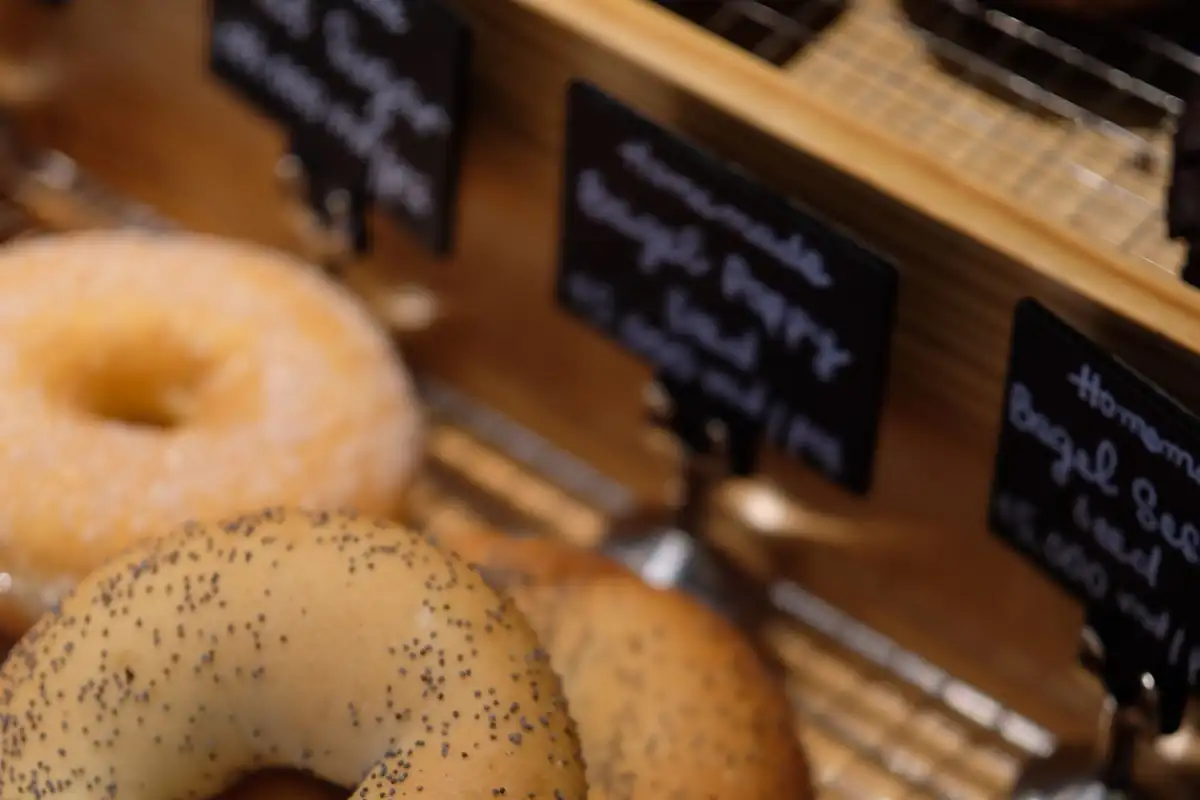
A real New York bagel is dense, chewy and shiny, nothing like a round roll with a hole in it. That comes from three things: a very stiff dough made with high-protein flour, a night in the fridge, and a boil before the oven.
At 57% this is one of the driest doughs you will make. It feels wrong if you are used to sourdough. Stick with it: the stiffness is what gives the chew.
Formula
Change the count or piece weight and every gram updates. Percentages are of total flour, including the flour in any starter or preferment.
| Ingredient | Baker's % | Weight |
|---|---|---|
| High-gluten or bread flour (13–14% protein) | 100% | 562 g |
| Water, 24 °C (75 °F) | 57% | 320 g |
| Barley malt syrupOr 3% brown sugar | 4% | 22 g |
| Fine sea salt | 2% | 11 g |
| Instant yeast | 0.7% | 3.9 g |
| Total dough | 920 g | |
| Total flour · water | 562 g · 320 g | |
| Hydration | 57.0% |
What does this cost to make?About $0.26 per bagel at example US prices
| Ingredient | Cost |
|---|---|
| High-gluten or bread flour (13–14% protein) | $1.61 |
| Water, 24 °C (75 °F) | $0.00 |
| Barley malt syrup | $0.32 |
| Fine sea salt | $0.06 |
| Instant yeast | $0.08 |
| Ingredients | $2.06 |
| Per bagel | $0.26 |
| Per 100 g of dough (ingredients) | $0.22 |
| Suggested retail price | $1.00 |
| Suggested wholesale price | $0.75 |
Retail is 3× cost (a 74% margin), rounded up; wholesale is 60% of retail. Example US prices (Nov 2026), ingredients only. Put in what you pay, plus packaging and your time, in the cost calculator.
Use your own prices →Nutrition per serving (estimate), 1 bagel · 265 kcal · carbs 53 g · protein 9 g · fat 1 g · fiber 2 g · sodium 545 mg. Worked out from the ingredient weights above, toppings and fillings included.
A scale makes every bagel the same weight so they boil and bake evenly. A sturdy half sheet pan carries them from fridge to pot to oven.
Why bagels are so dry
Most breads sit between 65% and 80%. Bagels go lower because they have to keep their ring shape through a boil and a hot bake, and the chewy, close crumb needs a tight dough. Push past 60% and they puff up like rolls.
What the boil does
Boiling sets the outside before the bagel goes in the oven. That limits how much it can rise, which keeps the crumb tight, and it gives the shiny, chewy crust. Malt in the water adds colour and a little sweetness.
Method and schedule
- Mix and knead : 15 min, hands-on.
- Rest : 30 min, waiting.
- Divide and shape : 20 min, hands-on.
- Cold rest overnight : 16 h, waiting.
- Float test : 15 min, hands-on.
- Heat the oven and the water : 15 min, oven, during float test.
- Boil : 15 min, hands-on.
- Bake : 20 min, oven.
Pick a start time, or the time you want it ready, and each step gets a clock time. Tick steps off as you go; this page remembers your place on this device.
Plan your bakeTotal time 17 h 55 min
1 Mix and knead
Dissolve the malt syrup in the water, add the flour, yeast and salt, and knead 10 minutes. It is a stiff dough. A stand mixer helps; by hand it is a good workout.
Look for: Smooth and satiny, and firm like modelling clay.
2 Rest
Cover and rest 30 minutes so the gluten relaxes enough to roll.
3 Divide and shape
Weigh into equal pieces. Roll each into a 25 cm (10 in) rope, wrap it around your hand so the ends overlap under your palm, and roll the join hard against the counter to seal it.
Shaping the ring - Roll a ropeAbout 25 cm long
- Wrap it around your handEnds overlap under your palm
- Roll the joinPress hard against the counter
Look for: An even ring with a seam you can’t see.
4 Cold rest overnight
Set them on an oiled, parchment-lined tray, cover and refrigerate 12–18 hours. This is where the flavour and the small blisters on the crust come from.
5 Float test
Drop one bagel into a bowl of water. If it floats within 10 seconds they are ready. If it sinks, give them 20–30 minutes at room temperature and test again.
6 Heat the oven and the water
While you test, heat the oven to 240 °C (465 °F) and bring a wide pot of water to a boil with 1 tablespoon of malt syrup per 2 litres. Start the oven earlier if yours is slow.
7 Boil
Boil the bagels a few at a time, 45–60 seconds per side. Lift out with a slotted spoon and dip the tops in seeds while they are still wet.
Look for: Plump and glossy, with a skin that looks slightly wrinkled until it dries.
8 Bake
Bake 16–20 minutes.
Look for: Deep golden, shiny, and they sound hollow underneath.
Troubleshooting
- Bagels sink in the float test: they need 20–30 more minutes at room temperature.
- Wrinkly bagels after baking: over-proofed or boiled too long. Cut the boil to 30 seconds per side.
- Rings come apart: the seam wasn’t rolled hard enough, or there was oil on the ends.
Baker's notes
Once you have made it as written, these are the changes worth trying.
- Use 1% diastatic malt in the dough alongside the syrup for a more bakery-like crust colour.
- For a sourdough bagel, replace the yeast with 20% starter and give the shaped bagels 2–3 hours before they go in the fridge.
- A little baking soda (1 tablespoon per 2 litres) in the boil gives a darker, more pretzel-like crust.
Questions
Can I use bread flour?
Yes. Bread flour at 12.5% protein or more works well. All-purpose makes softer, less chewy bagels.
Malt syrup or baking soda in the water?
Malt is more traditional for New York bagels. Baking soda gives a darker, pretzel-like crust.
How do I store bagels?
Keep them in a paper bag for a day. After that, slice and freeze them, and toast from frozen.
Bake next

Feedback on this recipe
Formula and method by the BreadHydration team, written for home ovens and checked against our calculators. Photo by bynamnamnam on Pexels, used under the Pexels license; it shows this style of bread, not our own bake. Found an error? Tell us.