Yeasted bread · Medium
Japanese Milk Bread (Tangzhong)
Soft, tall Japanese milk bread (shokupan) made with a tangzhong roux. The cooked flour holds extra water, so the loaf stays soft for days. Scale it to your pan.
- Hydration
- 70%
- Total time
- 5 h 7 min
- Hands-on
- 1 h
- Makes
- 1 loaf (9×5 in pan)
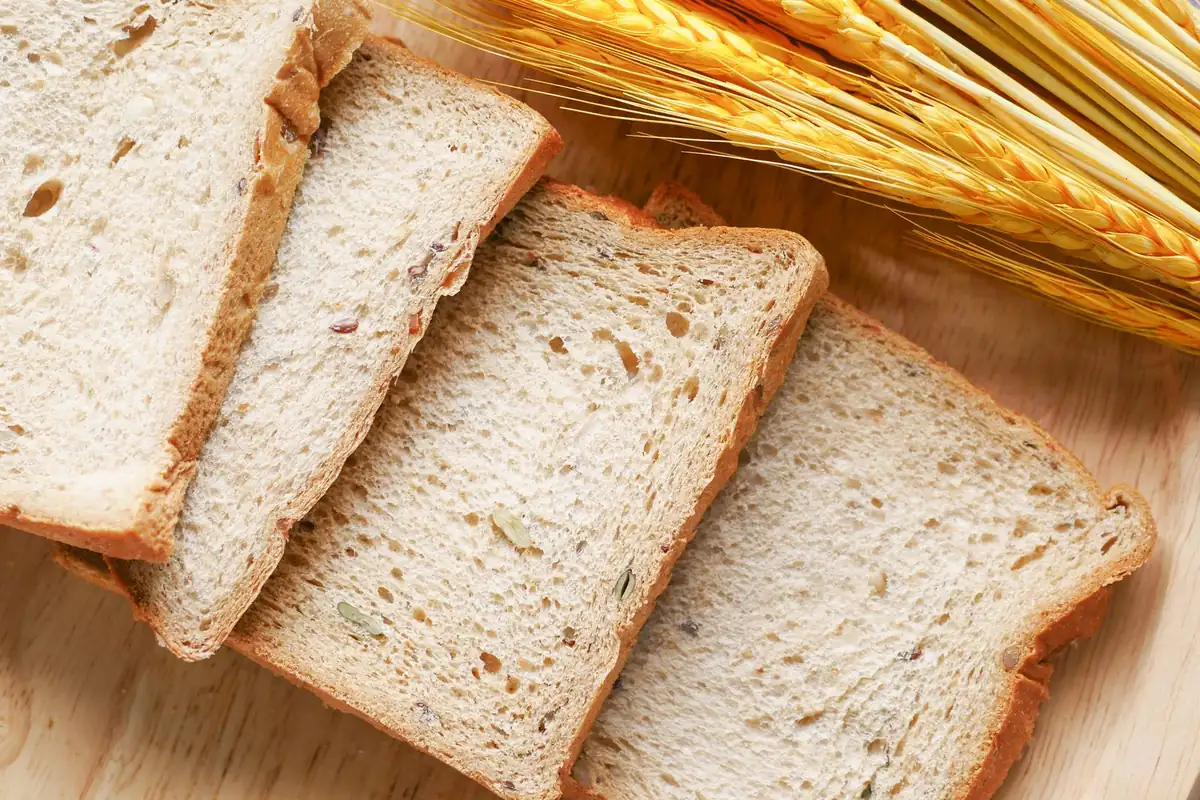
Japanese milk bread, or shokupan, is the softest loaf here: tall, fine and so tender it pulls apart in feathery strands. The trick is tangzhong, a little of the flour cooked in milk into a paste before it goes in the dough.
Cooked starch holds far more water than raw flour. So the dough carries about 70% effective hydration and still kneads like a much firmer one, and all that extra water stays in the crumb. Day three, it is still soft.
Formula
Change the count or piece weight and every gram updates. Percentages are of total flour, including the flour in any starter or preferment.
| Ingredient | Baker's % | Weight |
|---|---|---|
| Tangzhong | ||
| Bread flour | 5% | 19 g |
| Whole milk | 25% | 93 g |
| Dough | ||
| Bread flour | 95% | 355 g |
| Whole milkLukewarm | 45% | 168 g |
| EggAbout 1 egg per 500 g flour | 10% | 37 g |
| Sugar | 9% | 34 g |
| Instant yeast | 1% | 3.7 g |
| Fine sea salt | 1.8% | 6.7 g |
| Unsalted butter, soft | 9% | 34 g |
| Total dough | 750 g | |
| Total flour · water | 374 g · 261 g | |
| Hydration | 69.8% | |
What does this cost to make?About $2.23 per loaf (9×5 in pan) at example US prices
| Ingredient | Cost |
|---|---|
| Bread flour | $0.05 |
| Whole milk | $0.10 |
| Bread flour | $1.02 |
| Whole milk | $0.18 |
| Egg | $0.28 |
| Sugar | $0.08 |
| Instant yeast | $0.07 |
| Fine sea salt | $0.04 |
| Unsalted butter, soft | $0.41 |
| Ingredients | $2.23 |
| Per loaf (9×5 in pan) | $2.23 |
| Per 100 g of dough (ingredients) | $0.30 |
| Suggested retail price | $6.75 |
| Suggested wholesale price | $4.25 |
Retail is 3× cost (a 67% margin), rounded up; wholesale is 60% of retail. Example US prices (Nov 2026), ingredients only. Put in what you pay, plus packaging and your time, in the cost calculator.
Use your own prices →Nutrition per serving (estimate), 1/8 of the loaf (9×5 in pan) · 245 kcal · carbs 40 g · protein 7 g · fat 6 g · fiber 1 g · sodium 350 mg. Worked out from the ingredient weights above, toppings and fillings included.
The thermometer does two jobs: checking the tangzhong at 65 °C and the loaf at 88 °C. A loaf pan or Pullman pan holds the tall shape.
The tangzhong ratio
The usual ratio is 1 part flour to 5 parts liquid, using 5–10% of the recipe’s flour. This recipe cooks 5% of the flour in 25% milk. A little water steams off while it cooks; that doesn’t change the result.
Yudane is the close cousin: flour mixed with boiling water and rested overnight. It gives a similar soft crumb with a little more chew.
Counting milk, egg and butter
There is no plain water in this loaf. Milk is about 87% water, egg about 75% and butter about 16%, which is how the formula reaches about 70%. If you want to change the hydration, the bread hydration calculator takes total liquid in grams.
Method and schedule
- Cook the tangzhong : 10 min, hands-on.
- Cool the tangzhong : 20 min, waiting.
- Weigh the rest : 10 min, hands-on, during cool the tangzhong.
- Mix and knead : 15 min, hands-on.
- Add butter and knead : 15 min, hands-on.
- First rise : 1 h 15 min, waiting.
- Divide and shape : 20 min, hands-on.
- Final rise : 1 h, waiting.
- Heat the oven : 20 min, oven, during final rise.
- Bake : 32 min, oven.
- Cool : 1 h, waiting.
Pick a start time, or the time you want it ready, and each step gets a clock time. Tick steps off as you go; this page remembers your place on this device.
Plan your bakeTotal time 5 h 7 min
1 Cook the tangzhong
Whisk the tangzhong flour into the milk in a small pan. Cook over medium-low heat, stirring all the time.
Look for: It turns from milky to a thick, glossy paste and the whisk leaves lines in it, at about 65 °C (149 °F).
2 Cool the tangzhong
Scrape it into the mixing bowl, cover the surface and let it cool to lukewarm.
3 Weigh the rest
While it cools, weigh the flour, milk, egg, sugar, yeast and salt, and set the butter out to soften.
4 Mix and knead
Add everything except the butter to the tangzhong and knead 8 minutes.
Look for: Smooth, and it has stopped sticking to the bowl.
5 Add butter and knead
Work in the butter, then keep kneading until the dough passes the windowpane test: stretch a small piece thin enough to see light through without it tearing.
Look for: Silky and stretchy, with a thin, even windowpane.
6 First rise
Cover and let it rise at about 26 °C (79 °F) for 60–90 minutes.
Look for: Doubled. A floured finger pushed in leaves a hole that stays.
7 Divide and shape
Divide into 3 equal pieces. Roll each into an oval, fold the long sides in to the middle, then roll it up tightly from the short end. Stand the three rolls side by side, seams down, in a buttered 9×5 in (23×13 cm) pan.
8 Final rise
Let it rise for 45–60 minutes.
Look for: The three humps dome about 1 cm above the rim.
9 Heat the oven
Heat the oven to 175 °C (350 °F) for the last 20 minutes of the rise.
10 Bake
Brush with milk or beaten egg and bake 30–35 minutes.
Look for: Golden brown, and the middle reads 88–90 °C (190–195 °F).
11 Cool
Turn it out at once and cool on a rack. It slices cleanly only once it is fully cool.
Troubleshooting
- Dough too sticky to knead: keep going. It firms up after 5–8 minutes.
- Loaf caves in at the sides: under-baked. Bake to 88 °C in the middle.
- Dense crumb: under-kneaded. Butter-rich dough needs a full windowpane.
Baker's notes
Once you have made it as written, these are the changes worth trying.
- Raise the tangzhong to 8–10% of the flour for an even softer, more custardy crumb; reduce the dough milk by 5 g per extra 1% flour cooked.
- Replace 10% of the milk with cream for a richer, Hokkaido-style loaf.
- For a sourdough version, use 20% ripe starter instead of yeast, cut the dough milk by 10% and allow 4–6 hours for the first rise.
Questions
Can I use a Pullman pan?
Yes. For a 9×4×4 inch Pullman with the lid on, use about 600 g of dough and bake 35–40 minutes. Fill it too full and the crumb turns dense.
Can I make milk bread rolls?
Yes. Divide into 60 g pieces, shape into balls and bake at 180 °C for 15–18 minutes.
Tangzhong or yudane?
Both make soft bread. Tangzhong is quicker; yudane needs an overnight rest and gives a little more chew.
Bake next

Feedback on this recipe
Formula and method by the BreadHydration team, written for home ovens and checked against our calculators. Photo by Towfiqu barbhuiya on Pexels, used under the Pexels license; it shows this style of bread, not our own bake. Found an error? Tell us.