Yeasted bread · Medium
Cinnamon Rolls (Soft, Overnight Option)
Soft, tall cinnamon rolls from an enriched dough at about 59% hydration, with a brown sugar filling and cream cheese frosting. Bake the same day or rise overnight in the fridge.
- Hydration
- 59%
- Total time
- 3 h 25 min
- Hands-on
- 55 min
- Makes
- 12 rolls
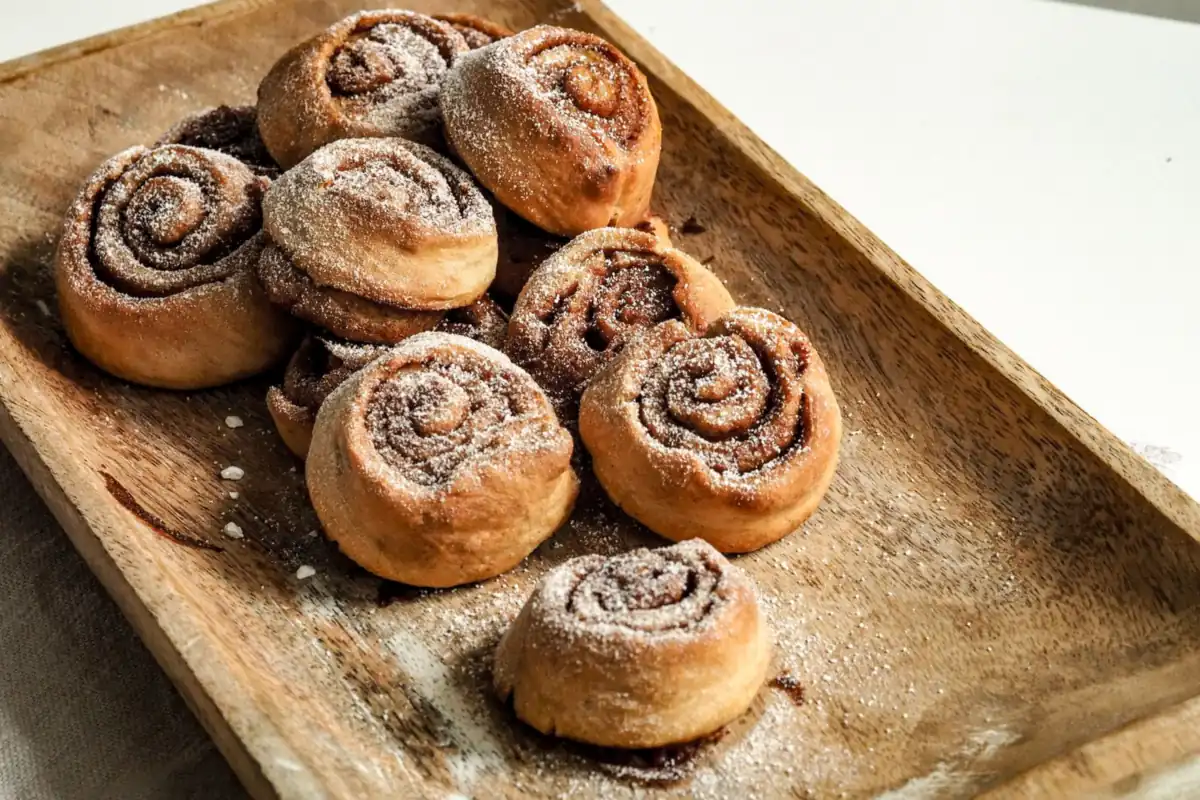
Good cinnamon rolls are soft all the way through, with a filling that stays in the spiral instead of pooling in the pan. Both come down to the dough: rich enough to stay tender, firm enough to roll tightly.
At about 59% hydration, counting the water in the milk, egg and butter, this dough rolls out without sticking and bakes up tall. The filling sits outside the hydration figure, as it does in bakery formulas.
Formula
Change the count or piece weight and every gram updates. Percentages are of total flour, including the flour in any starter or preferment.
| Ingredient | Baker's % | Weight |
|---|---|---|
| Dough | ||
| Bread flour | 100% | 460 g |
| Whole milkLukewarm | 55% | 253 g |
| EggAbout 1 large egg per 450 g flour | 12% | 55 g |
| Sugar | 12% | 55 g |
| Instant yeast | 1.2% | 5.5 g |
| Fine sea salt | 1.6% | 7.4 g |
| Unsalted butter, soft | 12% | 55 g |
| Filling | ||
| Unsalted butter, very soft | 16% | 74 g |
| Brown sugar | 22% | 101 g |
| Ground cinnamon | 3% | 14 g |
| Total dough | 1,080 g | |
| Total flour · water | 460 g · 270 g | |
| Hydration | 58.8% | |
What does this cost to make?About $0.43 per roll at example US prices
| Ingredient | Cost |
|---|---|
| Bread flour | $1.32 |
| Whole milk | $0.28 |
| Egg | $0.41 |
| Sugar | $0.13 |
| Instant yeast | $0.11 |
| Fine sea salt | $0.04 |
| Unsalted butter, soft | $0.67 |
| Unsalted butter, very soft | $0.89 |
| Brown sugar | $0.39 |
| Ground cinnamon | $0.97 |
| Ingredients | $5.21 |
| Per roll | $0.43 |
| Per 100 g of dough (ingredients) | $0.48 |
| Suggested retail price | $1.50 |
| Suggested wholesale price | $1.00 |
Retail is 3× cost (a 71% margin), rounded up; wholesale is 60% of retail. Example US prices (Nov 2026), ingredients only. Put in what you pay, plus packaging and your time, in the cost calculator.
Use your own prices →Nutrition per serving (estimate), 1 roll · 290 kcal · carbs 43 g · protein 6 g · fat 10 g · fiber 2 g · sodium 260 mg. Worked out from the ingredient weights above, toppings and fillings included.
A thermometer takes the guesswork out of baking: 88 °C in the middle roll means done. A bench scraper helps lift the dough as you roll it up.
Hydration in an enriched dough
There is no plain water here. Milk is about 87% water, egg about 75% and butter about 16%, which adds up to roughly 59% of the flour. Sugar and butter both make dough feel wetter than its number, so 59% handles like a lean dough in the mid 60s.
If you change the milk, the bread hydration calculator takes the total liquid in grams and tells you where you land.
Keeping the filling in
Use butter that is very soft but not melted. Melted butter runs out of the spiral as soon as the rolls warm up. Brown sugar holds more moisture than white and turns into a soft, sticky layer rather than a crunchy one.
Method and schedule
- Mix and knead : 15 min, hands-on.
- Add the butter : 10 min, hands-on.
- First rise : 1 h 15 min, waiting.
- Make the filling : 5 min, hands-on, during first rise.
- Roll, fill and cut : 20 min, hands-on.
- Second rise : 45 min, waiting.
- Heat the oven : 20 min, oven, during second rise.
- Bake : 25 min, oven.
- Frost and cool : 15 min, hands-on.
Pick a start time, or the time you want it ready, and each step gets a clock time. Tick steps off as you go; this page remembers your place on this device.
Plan your bakeTotal time 3 h 25 min
1 Mix and knead
Mix the flour, milk, egg, sugar, yeast and salt, then knead 8 minutes by hand or 5 on medium in a mixer.
Look for: Smooth, and it has stopped sticking to the bowl.
2 Add the butter
Work in the soft butter a piece at a time and knead until the dough is glossy again.
Look for: Silky and stretchy; a small piece pulls thin without tearing straight away.
3 First rise
Cover and leave it at about 26 °C (79 °F) for 60–90 minutes.
Look for: Doubled, and a floured finger leaves a hole that stays.
4 Make the filling
Near the end of the rise, beat the filling butter, brown sugar and cinnamon into a spreadable paste.
5 Roll, fill and cut
Roll the dough into a rectangle about 40×30 cm (16×12 in). Spread the filling to the edges, leaving a 2 cm strip bare on one long side. Roll it up tightly towards the bare strip and pinch the seam. Cut into equal pieces with dental floss or a sharp knife and set them cut side up in a buttered 9×13 in (23×33 cm) pan.
Look for: Even rolls with a tight spiral and no gaps.
6 Second rise
Cover and leave 40–50 minutes. For breakfast rolls, put the covered pan in the fridge overnight instead, then give it an hour at room temperature in the morning.
The poke test - Springs right backNeeds more time
- Fills in slowlyReady to bake
- Dent staysOver-proofed: bake now
Look for: Puffy and touching each other, and a gentle poke springs back slowly.
7 Heat the oven
Heat the oven to 180 °C (350 °F) for the last 20 minutes of the rise.
8 Bake
Bake 22–26 minutes. Cover loosely with foil if the tops brown too fast.
Look for: Golden on top, and the middle roll reads 88–90 °C (190–195 °F).
9 Frost and cool
For 12 rolls, beat 120 g soft cream cheese, 30 g soft butter and 90 g powdered sugar until smooth. Spread it over the rolls while they are warm, not hot.
Troubleshooting
- Filling pooled in the pan: the butter was melted, or the rolls were loose. Roll tighter and use soft butter.
- Dry, bready rolls: over-baked or too much flour while rolling. Take them out at 88 °C in the middle.
- Middles pop up in the oven: rolled too tight at the centre, or under-proofed. Give the second rise 10 more minutes.
Baker's notes
Once you have made it as written, these are the changes worth trying.
- For extra-soft rolls, cook 5% of the flour in 25% of the milk as a tangzhong, as in our milk bread recipe.
- Pour 60–80 g warm cream over the rolls just before baking. It soaks into the bottoms and makes them gooey.
- Swap the cinnamon for cardamom and add orange zest for a Scandinavian twist.
Questions
Can I make them the night before?
Yes. Shape them, cover the pan and refrigerate up to 16 hours. Give them about an hour at room temperature before baking.
Can I freeze cinnamon rolls?
Freeze them baked and unfrosted. Thaw, warm for 8–10 minutes at 160 °C, then frost.
Can I use all-purpose flour?
Yes. Cut the milk by 10–15 g per 500 g of flour, because all-purpose holds less liquid.
Bake next

Feedback on this recipe
Formula and method by the BreadHydration team, written for home ovens and checked against our calculators. Photo by Lara K. on Pexels, used under the Pexels license; it shows this style of bread, not our own bake. Found an error? Tell us.